Renovate Like You're Selling It Someday: How to Love Your Home Without Scaring Off Its Future Buyer

Photo: The Government-General of French Indo-China., Public domain, via Wikimedia Commons
Somewhere between the first design meeting and the final walkthrough, every homeowner hits the same fork in the road. One sign says "build what makes you happy." The other says "remember, somebody else owns this house after you."
We've watched clients wrestle with that decision on everything from a $40,000 kitchen refresh to a full second-story addition. And here's the honest answer from the contractor's side of the table: it's not either/or. It's about knowing which risks are reversible and which ones you'll be explaining to a future appraiser.
The Two-Column Test We Give Every Client
Early in planning, we ask homeowners to make two lists. Column one: things you'd fight to keep if you sold tomorrow. Column two: things you'd shrug about if a buyer wanted them gone.
The magic happens in column two. Those are your candidates for "bold but reversible" design—choices that express your personality without permanently rearranging the bones of the house.
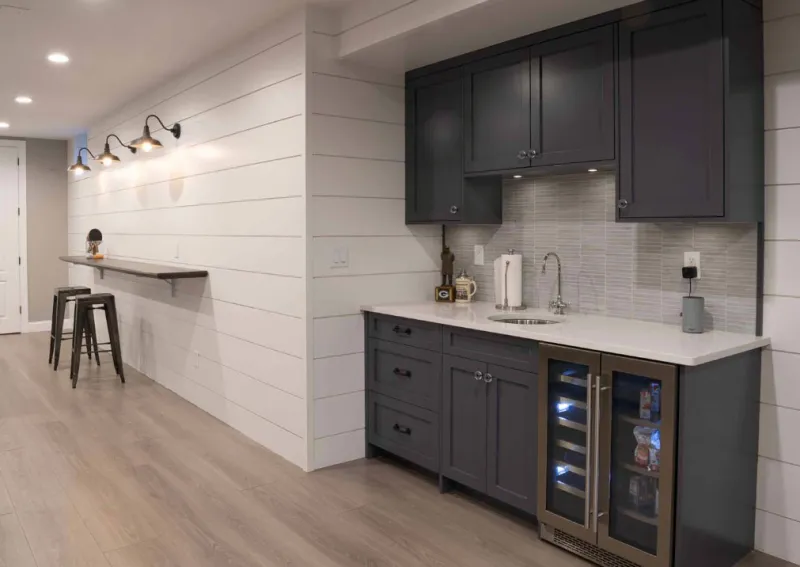
A wine wall is a great example. Done as a well-built feature in a finished basement, it's a striking showpiece and a weekend demo job if the next owner wants a media room instead. The same square footage still reads as flexible living space either way.
A home office carved out of a primary bedroom suite? Different story. You've changed the floor plan, the plumbing might follow, and the next buyer's agent will list that room as "bedroom (possible office)." You took a four-bedroom house and made it a three-bedroom with a nice desk.
What Actually Holds Value (According to Appraisers, Not Instagram)
If you want the boring truth, talk to an appraiser. The features that consistently move the needle on resale are rarely the fun ones:
- Kitchens and primary baths, as always, carry the most weight—but within reason. A mid-tier remodel with quality materials routinely outperforms a showstopper with exotic finishes.
- Square footage that adds bedrooms or bathrooms. A fifth bedroom beats a cigar room every single time.
- Mechanical and envelope work nobody sees. New roof, updated panel, insulation, HVAC. Buyers' inspectors find everything, and a clean report is worth real money.
- Curb appeal and the first ten feet inside the door. First impressions set the price anchor for the whole showing.
Notice what's missing: the dramatic, personal stuff. Nobody has ever lost a sale because they didn't install a pizza oven. Plenty of people have watched buyers mentally deduct $30,000 over one.
Where Homeowners Get Burned
The expensive mistakes usually fall into three buckets.
Over-improving for the neighborhood. A $150,000 chef's kitchen in a street of $400,000 colonials doesn't return $150,000. It returns whatever the neighborhood ceiling allows. We've talked more than one client out of this, and they've never thanked us less for it.
Highly specific single-use rooms. The home theater with tiered seating, the indoor putting green, the craft room wired for twelve sewing machines. Wonderful to live with. Brutal to market. If a room only works for one hobby, frame it so it converts—a theater is fine if the wiring and layout also suit a family room.
Trend-locked finishes. Remember terrazzo-everything and gray-on-gray-on-gray? The bolder and more of-the-moment your permanent materials—tile, counters, cabinetry color—the faster they read as "dated" instead of "designed." Trend belongs in paint, hardware, lighting, and textiles. Things you can swap in a Saturday.
Renovating Boldly, But With an Exit Ramp
Here's the approach we recommend to clients who want a house that feels unmistakably theirs without betting the resale price on it.
Go bold on layers, conservative on structure. Keep walls, plumbing locations, and room functions broadly conventional. Pour your personality into finishes, millwork, lighting, and color—things a future owner can change without a permit.
Design rooms to flex. A primary suite with a sitting area reads as luxury to you and "flex space" to a buyer. A finished basement with a wine wall and a wet bar reads as entertainment space to everybody. The label matters less than the underlying utility.
Document everything. Permits, engineering letters, warranties, material specs. A bold renovation with a paper trail reads as "professionally built." The same renovation with no records reads as "what were they thinking?"
Spend where inspectors and appraisers look. Every dollar on structure, systems, and weatherproofing protects both your daily life and your resale number. Every dollar there is a dollar that works twice.
The House You Build for the Next Owner
There's a mindset shift that helps: you're not building a product, you're building a chapter. Somebody else writes the next one. Your job is to write yours so well—and so thoughtfully—that the next person wants to keep reading rather than start over.
The clients who land this best are the ones who stop thinking "dream home versus investment" and start thinking "dream home that doesn't require the next owner to share my dreams."
Love the wine wall? Build it. Just build it in a room that still makes sense when it's gone.
That's not designing for someone else. That's good craftsmanship with good manners.