Two Weekends a Year: What That Guest Room Really Costs You
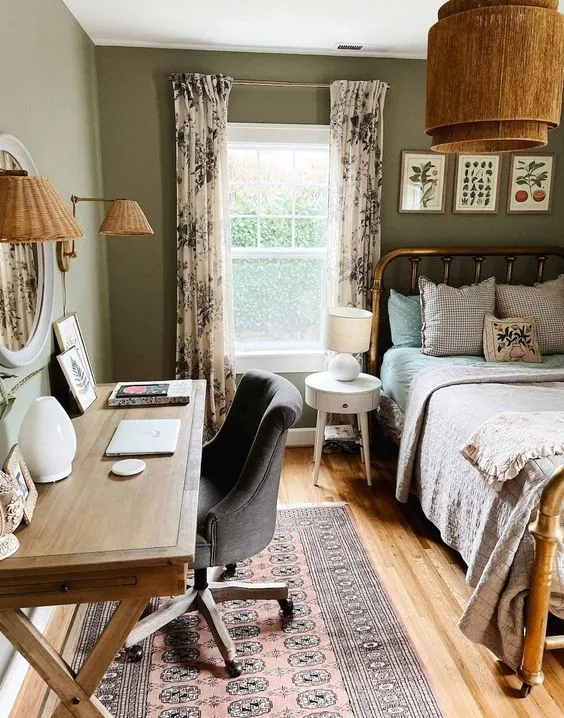
Photo: spare guest bedroom with desk multifunctional home office, via www.digsdigs.com
Every builder hears it eventually. Somewhere around the design phase, a homeowner mentions the guest room. Grandma comes twice a year. The kids visit at Christmas. Sometimes it's vaguer than that — "we just like having the space" — and the room gets framed, drywalled, heated, and cooled on the strength of a maybe.
We're not here to tell you to stop loving your family. We're here to suggest you run the numbers first, because nobody else in the process will.
Doing the Math Nobody Wants to Do
Grab a recent utility bill and your floor plan. Your house has a total conditioned square footage; your utility bill tells you roughly what it costs to keep all of it comfortable. Divide one by the other and you get a cost per square foot per month. In much of the US, that lands somewhere between $0.15 and $0.45 per square foot depending on the season and your climate zone.
Now measure the guest room. A modest 12x14 bedroom with a closet runs about 190 square feet of conditioned space. At $0.30 a square foot, you're spending $50 to $70 a month keeping it comfortable — roughly $700 a year, every year, whether or not anyone sleeps there.
Add the amortized construction cost if the room was an addition, the furniture gathering dust, the paint refresh every decade, and the light bulbs you replace in a room you walk through twice a month. Over a 20-year mortgage, that "free" guest room can quietly cost $30,000 to $50,000 all in.
Nobody budgets for this. It just happens, one utility bill at a time.
The Honest Usage Audit
Before you renovate anything, track the truth for 30 days. A $12 door sensor or even a sticky note tally on the doorframe works. Count every time the room gets used for its intended purpose.
We've watched homeowners do this and discover their "guest room" gets used four times a year — but the reading nook in the corner gets used daily. The spare bedroom is a shrine to a function that barely exists, while the function that does exist has no dedicated home.
That's not a guilt trip. That's data. And data beats habit every time.
Reprogramming, Not Demolishing
Here's the good news: most underused rooms don't need construction. They need a job description.
The hybrid room. A real bed (not a sofa sleeper your guests secretly hate) can share space with a wall-mounted desk, a full-height bookcase, or a craft station. Guests sleep comfortably two weekends a year; you get a functional office or studio for 360 days.
The zoning play. If your HVAC system allows it, ask about zoning that guest wing separately, or closing registers and using a mini-split with its own controls. Why condition 190 square feet to 72 degrees in July for a room that's empty? A ductless mini-split in a converted space lets you heat and cool it only when it's occupied. That alone can claw back a few hundred dollars a year.
The flex room. Some of our clients go further — a room that works as a guest suite, a home gym, and a movie den, with storage designed so the conversion takes fifteen minutes, not an afternoon of furniture Tetris.
What Builders See From the Other Side
When someone asks us to add a guest suite onto the back of the house, we ask one question: "How many nights a year?" Not to talk them out of it — sometimes the answer genuinely justifies it. Multi-generational living is real, and aging parents moving in is a growing trend across the country.
But when the answer is "a handful of weekends," we'd rather design something smarter: a finished basement bedroom that costs a fraction of an addition, a Murphy bed wall that disappears into the millwork, or a bonus room above the garage that earns its keep as a hangout space the other 51 weeks.
The best rooms in a house are the ones that work every day. The second best are the ones that cost nothing on the days they don't.
A Simple Rule to Build By
Before you add, convert, or even redecorate a room, ask: what is this square footage doing for me in an average week? If the honest answer is "holding a bed for company," you can do better — with your budget, your energy bills, and the way you actually live.
Houses are expensive. Every room should pull its weight, or at least share the load.