Where You Actually Walk In: Turning the Garage Entry Into the Hardest-Working Spot in the House
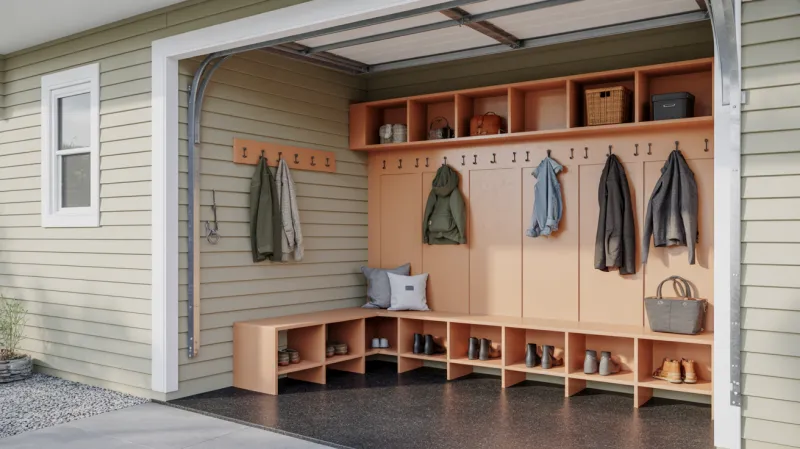
Photo: garage entry mudroom drop zone bench hooks, via menagehouse.com
Be honest for a second. When was the last time you actually walked through your front door with groceries in hand? For most American homeowners, the answer is basically never. We come home the same way every day: pull into the garage, hit the button, and shuffle through that little door into the house with an armful of backpacks, gym bags, and whatever the kids left in the car.
And what does that doorway look like? Usually a bare slab of drywall, a builder-grade door, maybe a lonely hook someone screwed in during 2014. It's the most-used entrance in your home, and it's treated like an afterthought.
We think that's backwards.
The 15-Foot Rule
Here's a framing we use with clients: the first fifteen feet of your arrival matter more than the next fifty. The hallway between your garage and your kitchen is where life actually happens—shoes come off, mail gets dropped, the dog needs feeding, and somebody absolutely cannot find their cleats.
Design that zone with intention and your whole house runs smoother. Ignore it, and the clutter doesn't disappear—it just migrates to your kitchen counters.
Start With the Floor
Garage entries take a beating. Snow, salt, rain, grass clippings, whatever the driveway tracks in. That builder-grade vinyl or thin paint isn't going to survive it.
For a floor that lasts, we lean on porcelain tile rated for freeze-thaw conditions, sealed concrete, or luxury vinyl plank with a solid wear layer. Tile is the workhorse choice—it shrugs off wet boots and mops clean in thirty seconds. If you go LVP, don't cheap out; the bargain stuff will curl at the seams after one wet winter.
Add a drain if the space allows. It sounds like overkill until the first spring thaw.
Build the Drop Zone, Not a Pile
The magic of a good garage entry is giving everything a home. Not a basket that becomes a junk graveyard—a real home.
What works:
- Hooks at multiple heights. Kids' coats down low, adult gear up top. Double the hooks you think you need.
- A bench with storage underneath. Somewhere to sit and wrestle snow boots off, with a cubby for each family member.
- Closed cabinets for the ugly stuff. Batteries, flashlights, dog leashes, returns waiting for a Target run. Doors hide sins.
- A landing counter or shelf. Keys, wallets, the mail you haven't opened. One flat surface, that's it.
The mistake we see most often is going too pretty and not practical enough. Shiplap is lovely, but if there's nowhere to put the backpack, it's ending up on the floor next to it.
Don't Skip the Door Itself
That garage-to-house door is also a fire separation barrier, and code requires it to be fire-rated. When you upgrade, use a solid-core, fire-rated door with a good seal. It quiets the garage, keeps out exhaust fumes, and holds up to a decade of daily slamming.
While you're at it, add a deadbolt or at least a quality lock. An attached garage is a common entry point in break-ins, and a lot of those interior doors are, frankly, a joke.
Light and Air: The Details That Sell It
Garage entries are usually dim and stuffy. Two fixes that transform the feel:
- Layered lighting. An overhead fixture plus a task light over the drop zone. Warm temperature, on a switch you can hit the second you walk in.
- Ventilation. If there's an exterior wall, even a small operable window does wonders for clearing out car exhaust and that garage smell nobody can quite name.
What It Costs (Roughly)
A straightforward garage entry makeover—flooring, paint, stock cabinets or open shelving, bench, hooks, lighting—typically lands between $3,000 and $8,000 depending on finishes and your market. Full custom millwork with a rebuilt closet can push past $12,000.
Compare that to a kitchen remodel, and it might be the best dollar-for-dollar quality-of-life upgrade in the house. You'll feel the difference every single day, twice a day minimum.
The Front Door Still Matters—But Be Real
None of this means the front porch goes neglected. Curb side, your front door sets the tone for guests and appraisers alike. But for the people who actually live there? The garage entry is home base. Design for the life you live, not the life you imagine.
So here's the challenge: walk in through your garage tonight and really look at those fifteen feet. What's working? What's a pile? Bring us a photo of that mess, and we'll show you what it could become.